Categories
Banking Credit Cards Debt

What it’s like to be a subprime debt collector

For TalkPoverty, a publication of the Center for American Progress, I interviewed subprime debt collectors about their difficult role as intermediaries between Americans in dire financial straights, and the financial institutions posting big profits.

Categories
Credit Cards Debt Financial Regulation

How the lessons of Tide Pods could clean up the credit card industry

While popular, Tide Pods are staggeringly dangerous for young children and people with disabilities.

Proctor and Gamble launched the Tide Pods in 2012.  In 2011, 2,862 children were hospitalized because of laundry-detergent related injuries. In 2013, that number was triple: 9,004 children were driven to hospitals by laundry detergent.  

The problem isn’t that Tide Pods are uniquely toxic, or contain chemicals never used before. The problem is that they’re cute. They’re colorful. And they’re small. It’s the good things about Tide Pods that we have to change to make them safer.  

What Tide Pods teach us about consumer product safety is that it’s not always the “bad parts” of products that make them risky: products aren’t always risky because of a gear that breaks and causes an accident, faulty wiring, or a toxic ingredient.  Tide Pods drove children to the hospital not because they had more bad parts than other detergents, it’s because they had more good parts: they looked better and felt better. A bill put forth in the New York State Assembly would force detergent packets sold to be in “opaque, uniform colors” — unlike the squishy, candy-like, blue-white-and-orange Tide Pods sold today. Seems like a good thing to me: changing the color scheme may make the product less popular, but won’t make the product any less effective.  

To help get Americans out of debt, regulators need to force banks to make their financial products less like squishy, colorful candy. We need ugly detergent that is just as good at cleaning clothes but poisons fewer children. We also need financial products that are equally good at helping families navigate a challenging economy but that tap into fewer of our weaknesses and biases.

Despite a handful of useful credit card regulations passed in 2009, too high of a percentage of Americans paychecks still get lost to loan interest and fees. While student loan debt dominates the news cycle, more American families hold credit card debt than any other form of loan: roughly half of all Americans carry an interest-bearing balance on credit cards.  Last year, Americans paid more than $104 billion in credit card fees and finance charges: an average of $823 per American family.  In the face of unstable and low-paying jobs, credit cards and other consumer lending products can sometimes help families plug goals and pay gaps, but clearly turning over $823 from American paychecks to big banks ultimately makes the problem worse.

Credit limit increases and credit card rewards are two “features” that make credit cards dangerous — and both “features” could be regulated in ways that wouldn’t make it harder for the Americans who actually face short term borrowing needs.

Banks should be required to get the customer’s permission before raising their credit limit. 

Imagine you’re on a diet and you’re trying hard to cut back on sweets. Many of us find it hard to turn down the plate of cookies sitting out in the break room, even if we’d be unlikely to go down the block to buy dessert. Similarly, for the many Americans struggling to make ends meet, a high credit limit is an unwanted invitation to take on debt they know will cause stress and heartache. Researchers Scott Schuh from the Federal Reserve Bank of Boston and Scott L. Fulford of Boston College found that for Americans who borrow money on their credit cards “nearly 100% of an increase in credit limits eventually becomes an increase in debts.”  There’s a huge psychological difference between applying for a new loan versus using credit that’s already available on a credit card you have. You might not apply for a new loan to go to your cousin’s wedding, even if you’d charge it to an existing card without knowing when you’ll pay it back. Moreover, too many consumers think of the credit limit as the amount banks think they can ‘safely afford’ to borrow. 

The U.S. regulatory framework says a high credit limit is a good thing, implying issuers shouldn’t need your permission to raise your credit limit, but a quick scan of Twitter reveals that many consumers feel different when they say things like: “Got an email that my credit limit has been raised and that is so dangerous how do I decline ”  If customers had to request credit limit increases they actually wanted, instead issuers raising customer credit limit without customers prior consent, a high unused credit line wouldn’t be looming over so many Americans heads as an unwanted temptation to enter a debt trap. Australia and the United Kingdom are both good case studies here. Australia prohibits banks from raising credit limits except at the customer’s request, and in the United Kingdom, banks can’t raise the credit limits of people who haven’t been able to repay their card balance in full at least once over the last year. 

Credit card rewards are another trojan horse. For some consumers of course, the airline miles or cash back is huge boon — there’s no doubt that for Americans who pay their bill in full every month, getting 1% or 2% back on purchases is a nice perk. But Schuh has shown that to cover the cost of these rewards, banks have to charge high “interchange” fees to merchants, which in turn result in higher prices for consumers. Perhaps more importantly, credit card rewards make it even more tempting for people to spend money they don’t have. The European Union and Australia have both capped these credit card processing fees charged to merchants, which effectively eliminated rewards credit cards in those countries. And good riddance. Simpler products with fewer distinct terms make it easier for people to select the lowest cost option: consumers would find it easier to identify the lower-interest-rate cards if they weren’t also benchmarking the value of airline miles. And there’s no reason low-income Americans who don’t qualify for credit cards to begin with should pay higher prices at merchants to allow wealthy Americans with Chase Sapphire Reserve cards can fly first class to Japan. 

While payday lenders charge exorbitant rates and fees, the one thing you can say in defense of payday loans is that they are typically used by people who are explicitly conscious of the fact they’re borrowing money, and are aware it’s not going to be cheap. By contrast, credit cards are slippery, intractable instruments in a country where only 38% of jobs pay enough for people to afford a middle class life, and living within your means can be a constant struggle. Occasionally borrowing on a credit card is the right answer for a family: economists Kyle Herkenhoff and Gordon Phillips have found that unemployed Americans with more credit card liquidity are able to extend their job searches by putting bills on their credit card, ending up with higher paying jobs as a result. But many Americans come to find that despite their irregular income or unexpected expenses, using a credit card to smooth things over just makes their budget shortfalls more and more severe as time passes. Ending unsolicited credit limit increases and taking steps to curb credit card rewards wouldn’t limit Americans from accessing credit when they need it — unlike capping credit card interest rates, as Bernie Sanders and Alexandria Ocasio-Cortez have proposed, which would undoubtedly increase how many Americans get declined when they apply for new credit.

 By going after some of the seemingly attractive features of credit cards, we can make them less like multicolored detergent pods, and stop the banks from taking Americans to the cleaners. 

Categories
Credit Cards Debt Road Trip

18 states later, some reflections

I just finished my road trip. The goal was to learn about the impact that credit cards and payday loans have in Americans’ lives. I’m now back in Washington, D.C. If you haven’t already read the previous blog posts, here were some of my reflections from Michigan and Missouri

Now that I’ve interviewed folks in 18 states for this project (well 17 states, plus the District of Columbia which obviously should be a state!), here are themes on my mind.

“Impatience” isn’t the problem

In Sacramento, I talked to Kathryn, a 63-year-old woman with $60,000 in credit card debt, which she’s whittled down from a peak of $80,000.

Kathryn worked as a nurse for 13 years before becoming a stay-at-home mom in a small town east of St. Paul, Minnesota, near the border with Wisconsin, nearly half an hour from the closest grocery store. Kathryn got divorced right as her youngest kid was starting college. She suddenly found herself alone in a home, surrounded by other people’s stuff: her ex-husband took half the things they’d bought together, and the realtor staged the house with model furniture. Even though the divorce agreement said the full amount of alimony wouldn’t take effect until the house sold, she went ahead and moved into an apartment anyway—it was too depressing to stay in the empty home—without realizing how long it would take to sell the house. The Great Recession was deepening. She racked up credit card debt between attorney’s fees, her car payment, and paying rent while she waited for the full amount of alimony to kick in.

At the same time, she still wanted to help put her three kids through college, and continued to send them cash despite being deeply under water.  In writing about credit card debt, economists Scott Schuh and Scott Fulford have said that “more than half the population must be very impatient and care little about risk to hold the amount of revolving debt we observe.” Of course, that framework doesn’t really square with putting your children’s well-being ahead of your own, an act that is deeply future-oriented. More broadly, the schema of “I could have one marshmallow today or two marshmallows tomorrow” is only rarely appropriate for the actual types of trade-offs families are making when it comes to debt.

One additional reflection on marshmallows from this trip:

Vegan marshmallows will definitely melt in your car

Wrap those bad boys up!  

It’s time for credit cards to have their comeuppance

According to data from the 2018 Federal Reserve Survey of Household Economics and Decision Making, 91 million Americans have unpaid credit card debt. While 96 million adults said they paid their credit card bill in full every month, a larger number, 106 million, said they carried an unpaid balance at least once over the last 12 months. More than half of those — 54 million — said they had unpaid credit card debt most or all of the time. 

Despite the fact that credit card debt is still a central challenge in people’s lives, student loans have sucked all the air out of the room when it comes to talking about debt. It’s easy for people with student loan debt to contextualize the problem as basically a societal one: the byproduct of higher tuition and broken promises. And, of course, the fact that people signed on the dotted line when they were just 18 years old makes it relative easy for them to feel angry instead of embarrassed.  By contrast, people deeply internalize the shame of being in credit card debt. I talked to a woman in Seattle who had just moved from Michigan looking for work. “Credit score hinders everything [….] it was tight to get things established,” she said. At the same time, she added, “It’s the individual that gets themself in debt.” At least two Democratic front-runners have proposed cancelling most student loan debt, while proposing to wipe out credit card debt would be more or less unfathomable in our current political climate. Student loan debtors are depicted as sympathetic and credit card debtors are depicted as irresponsible. 

Geography matters

On this trip, I talked to people moving from basically every part of the country to basically every part of the country without having a job lined up in advance — in some cases people who literally were moving to and from opposite places.

There’s a lot of places where it’s taken as given you won’t get ahead unless you jump ship. Explaining why his daughter had racked up so much credit card debt, Curtis, a veteran and artist in Council Bluffs, Iowa, said, “She had the best opportunities […] She majored in arts education and she wanted to teach art. She didn’t want to relocate, and if you don’t want to relocate you’re a done deal.” 

But there are definitely no set rules for how you’re supposed to go about relocating to make ends meet, when big cities have high costs of living, and smaller towns have few jobs. The lists of “best places to live in America” would be pretty useless to anyone actually figuring out where to go: the variables that actually matter are probably things like the unemployment rate, the median income for people without a college degree, the 40th percentile of prices for a studio apartment, and whether or not the state expanded Medicaid. 

I’m still especially interested in the “Ability to Pay” doctrine. In 2010, Congress passed legislation saying credit card company couldn’t issue consumers a credit line unless they could demonstrate the customer could pay the loan back at their current income. More recently, the Consumer Financial Protection Bureau has been going back and forth on implementing rules that would do the same thing for payday loans: effectively outlawing lending money to people who are unemployed. The logic is clear: it can cause outsize harm to lend someone money if you have no idea whether they can repay you, especially because it normally means that you’re charging such high fees that you can break even, even if the customer defaults. And yet, what does it mean for literal mobility in this country if it’s illegal to lend someone enough money to buy a Greyhound ticket and stay at a hostel until they line something up? 

What’s next

I’ll be continuing research for this project, and I’m still hoping to talk to more people with experiences with credit card debt, personal loan debt and payday loan debt. If that’s you or someone you know, please drop me a line. I’m moving more into the manuscript phase of this project. It’s been exciting over the last few days to be making progress every day in telling Americans’ stories. I’ll be writing some standalone pieces this fall, as well, and potentially doing some consulting work, at a much lower number of hours than this past spring.

Here are some of the topics I’ve been thinking about outside of my major debt project:

  • Wage theft: I’m increasingly fascinated both by all the scams employers use to avoid paying people, and why some states/cities refuse to create a climate that would hold employers accountable– when even the most ‘free-marketeers’ among us agree that people should get paid the amount they’re owed for work.
  • The consequences of natural disasters for households: I’ve been talking to people in the Houston area about how Hurricane Harvey impacted their personal finances. I’m especially interested in the phenomenon of people using their disaster relief to pay off student loans while foreclosing on their homes. I’m also interested in efforts across the country to ensure fair labor standards when we rebuild after natural disasters. 
  • The Community Reinvestment Act: What affirmative obligations should be placed on banks? When this legislation was written, the phenomenon of “they’ll take my deposits but won’t lend to me” was a common critique, especially for minority families: now, it seems like predatory lending is rampant and people can no longer count on getting a free checking account.
  • Housing crises in rural areas: I talked to people in Red Oak, Iowa, about how areas of concentrated poverty sprung up after FEMA redrew their flood maps. I’m interested in the forces that create housing affordability challenges outside of places like New York and San Francisco. 
Categories
Banking Credit Cards Debt Financial Regulation Road Trip

The space between want and need

I’m now on Day 13 on my road trip at my aunt and uncle’s farm in Blue Earth County, Minnesota — today is the first day of the planting season for corn. It’s getting a late start because of all the rain. My next stop will be in Iowa.

If there’s one comment that has come up in most of my interviews with the people who wished they hadn’t borrowed money on a credit card, it’s that they used the card for things they realized they “didn’t really need.” That word “really” hints at the notion that there is actually a lot of ambiguous space in between want and need.

Peggy in St. Charles, Missouri started borrowing money on a credit card when she was pregnant to buy a new mattress — carrying around another person inside made it too hard to get in and out of her old water bed. Tasha in Milwaukee had “known” not to borrow money on a credit card for non-essentials. However, at times, she’d semi-consciously use up the money in her checking account on the things she wanted so that she’d have no choice but to borrow money on her credit card for the things she needed. It was a mental trick she used to let her evade her own rules of thumb.  

One of the greatest sources of ambiguity between “want” and “need” is family and tradition. All over the world, people who have been scraping by have found ways to set aside cash to celebrate weddings and to give their loved ones dignified funerals, whether that would mean working 14-hour days or by forgoing more quotidian “needs” like putting plumbing in their house. You can look at these choices as the actions either of status-obsessed people bowing to social pressure, or a recognition of the fact that our relationships to our families and communities are the greatest source of meaning and purpose that most of us have.

In one of the interviews I did before this trip, Joe in Washington, D.C., told me he wished he had forgone getting into credit card debt to buy new clothes, but that he’d never regretted borrowing money to buy last-minute plane tickets to see his long-distance girlfriend when she was feeling down. And similarly, when Kathryn thought about the credit card debt she’d accrued attending her sister’s and best friend’s weddings while in grad school, she said that while she now felt like she was “stuck in peanut butter” financially, it was hard for her to imagine not having stood beside the people closest to her.

Of course, throwing children in the mix complicates things further. I’ve talked to so many people who will figure out how to make things work and accumulate some savings on shoestring budgets when they’re only looking out for themselves. Yet, when it comes to their children, they have a hard time saying no. Is buying a uniform so your kids can join a sports team a want or a need? What about spending the $10 so they’re not the only one in their class left out of a field trip? Parents want so badly to provide for their children not only a sense of security, but also of normalcy, and of the magic of childhood — perhaps explaining why Federal Reserve data indicates that Americans accumulate an extra $19 billion of credit card debt in the fourth quarter of each year (around Christmas) compared to the rest of the year.

I’ll never forget one interview I did many years ago with a woman in Boston who’d accumulated most of her credit card debt bailing her kids out when they’d gotten into trouble — replacing a car they’d wrecked, or floating them when they couldn’t find work. She said that all her life she’d tried to make responsible choices, but that now she had no idea if or when she’d be able to retire (she was in her 60s). “I couldn’t bear to say no to my kids if I was able to afford it — but, in hindsight, the fact that I got into debt means that I never was able to afford it all along.”*

One of the ways that credit cards can mess with our heads is that it’s so easy to think of our credit limits as an “asset” or a “resource” that we can draw down. That way of thinking is so dangerous! Obviously a credit limit has a literal meaning — the amount we can charge on that particular credit card todayif we want to — but attributing any further meaning to that number gets so many people in trouble. The credit limit isn’t necessarily how much credit we could easily get access to. Many people with even below-average credit scores could get more in days or weeks by applying for credit limit increases with their existing cards, or by applying for new credit cards or loans. And the credit limits are certainly not how much money we could afford to pay back. By having available credit on her credit cards, it felt to the woman in Boston that she was able to say ‘yes’ to her adult children. She probably wouldn’t have felt that way if saying ‘yes’ to them had meant applying for a new loan.  

In the words of Alexandria Ocasio-Cortez, we need to reject a society that tells people, “If you choose to have any expense beyond mere animalistic survival – an iced coffee, a cab after an 18 hour shift on your feet – you deserve suffering, eviction, or skipped medicine.”

At the same time,  the personal finance advice that tells people to be careful about spending money on things they want but can’t afford today, because it could lead to suffering, eviction, or skipped medicine tomorrow, is true! Borrowing money for wants today usually means forgoing money for wants and/or needs tomorrow, and sadly, borrowing money for needs today can mean forgoing even more dire needs tomorrow.

When I worked in the credit card industry on developing the policies for credit limit increases, I would often zoom in to the level of individual borrowers to see what the proposed policy would have meant for them. Especially if a new rule would mean we were giving out credit to fewer people, I would see what that decision would mean in terms of purchases a given impacted customer would have to forgo. Often you see purchases that are pretty basic: $30 on groceries or gas, a few hundred dollars at a Mr. Tire. Other purchases are obviously discretionary: a Carnival cruise, fireworks, iTunes. Many others it would be impossible to say from the outside — spending at Walmart might be electronics or groceries, or at Lowe’s you might be fixing a broken window or replacing something that just looks dated. It might even be impossible to say from the inside!

Unsolicited or “automatic” credit limit increases to existing customers are a major part of how banks and credit card companies give out credit, and in turn, how Americans end up in debt. Just the other day, I talked to one of my cousins whose first credit card gave him a $500 limit, a limit which is now over $10,000. That trajectory is extremely common.

Banks could and should stop granting “automatic” credit limit increases to customers who are still paying interest on discretionary purchases they made months ago — they shouldn’t be trying to profit off of financial decisions that are going to cause Americans to struggle. This idea isn’t about looking at people and judging them in a moral sense – saying “shame on  you, you shouldn’t have bought that iced coffee.” It’s about not pushing people into holes they’re going to struggle to get out of. Operationally, I can say with great certainty that implementing this type of proposal at a bank would be no more complicated than all the things banks do on a quarterly basis to increase profits. And compared to Bernie Sanders and Alexandria Ocasio-Cortez’s proposal to cap credit card interest rates at 15 percent, this change would similarly prevent a massive proportion of  the high interest credit card debt that causes people to struggle, without having as large of an impact the access to credit that so many people rely on to make ends meet when there’s so safety net in place (like when people put their cancer medications on their credit cards while they’re arguing with their insurance companies to reimburse them.) The interventions in banking that make sense to implement today, in our current world, where people have few places to turn when things go wrong, are very different than the interventions in banking that would make sense to implement in a country with universal healthcare and basic income.

Of course, the idea that banks should stop raising credit limits of people who are still paying interest on past discretionary purchases would be fairly difficult to write into law: it’s more the type of thing a credit union or bank could choose to do on to better serve their customers, and hence, not something we should be expecting when it means they’d be forgoing big profits. One NerdWallet study reported that 86% of Americans with credit card debt regret it. If it was their primary goal, I have no doubt banks could find ways to do many fewer loans at terms or in circumstances where the borrower would ultimately feel regret, while barely making a dent in credit access under the terms and in the circumstances where the loans helped people succeed. To hear those proposals, keep reading in the weeks and months ahead.

* Just a quick comment that this particular quote is a paraphrase, unlike all other quotes that appear on this blog.  This conversation was before I started the research for this project, and hence, unlike all the interviews I’ve conducted over the last 9 months, I don’t have a recording and/or time-of notes.

Categories
Credit Cards Financial Regulation

Are credit card rewards even good for consumers?

Earlier this week, the Wall Street Journal reported that merchants like Home Depot, Target, and Amazon are becoming increasingly frustrated with the high fees they pay to accept rewards credit cards, and are seeking relief from the courts or through negotiations with Visa and Mastercard.   Particularly, merchants are looking for the networks Visa and Mastercard to end their ‘honor all cards’ rules, which say that if you accept any Visa credit card you need to accept all Visa credit cards, and ditto with Mastercard.

Today, if you spend $100 at a large grocery store, Visa would charge the store a $2.20 processing fee if you used a top-tier rewards credit card from their Visa Infinite line (like Chase Sapphire Reserve), a $1.75 fee you used a Visa Signature rewards credit card (like the Bank of America Travel Rewards Card), and $1.25 fee for any other Visa credit card, which are generally those without rewards.  By comparison, to accept a debit card, the processing fee would be 75 cents or less.
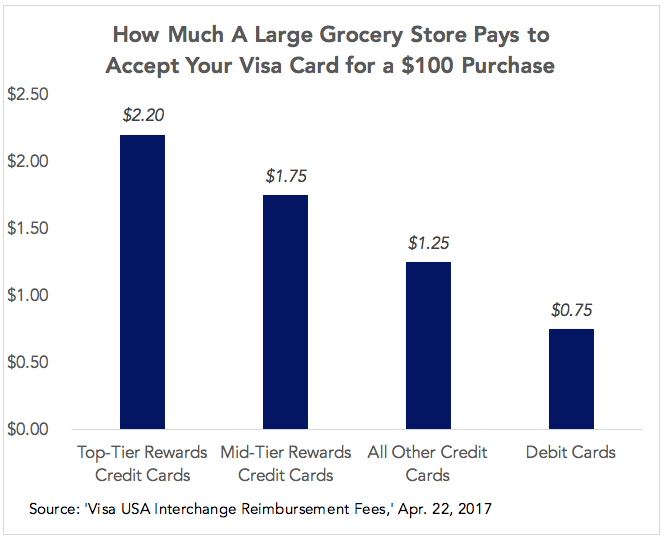
How much a large grocery store pays to accept your Visa Card for a $100 purchase; source Visa USA Interchange Reimbursement Fees

The article points out that rewards credit cards are incredibly popular with consumers – but do consumers actually win in the current system where merchants pay a fee to the networks (Visa, Mastercard, Amex and Discover), the networks pay issuers (Chase, Citi, Capital One, etc.), with much of the final fee getting sent back to customers in the form of rewards?

On the surface, the Americans who avoid paying interest on their credit card by paying their bill in full each month are getting a great deal – a family spending $1,000 per month on their credit card can easily net $200 per year in “free cash” from rewards.  Beneath the surface, things get more complicated.

A regressive system 

The most obvious flaw with the current system of processing fees and rewards is that stores raise prices to cover the fees – and because giving out a 1% or 2% percent discount to people who are paying with cash or a debit card can be clunky, those prices are usually higher for everyone, not only those paying with a rewards credit card.  On balance, that system is regressive, given that the Americans who primarily shop using their credit card are wealthier than the Americans who primarily shop using cash and debit.   Researchers at the Federal Reserve of Boston found that because of the price effects associated with credit card rewards, the lowest-income households, those that make $20,000 or less annually, pay an extra $21 per year in higher prices, and the highest-income households, making $150,000 or more annually, receive an extra $750 every year in rewards.

It was with these prices effects in mind that Australia and the European Union both passed rules limiting credit card processing fees to less than 1%.

But there’s another, more subtle, reason why credit card rewards may not be the boon to consumers that they’re made out to be.

Confusing the shopping experience

While some consumers use credit cards purely for the  rewards and convenience, 60% of active credit card users are “revolvers” who borrow money and pay interest on their credit cards.

For consumers that are going to borrow money using their credit card, picking out their credit card based on the rewards is like buying a house because you like the color they painted the bedroom – it just really shouldn’t be the most salient feature.

Credit card interest rates vary significantly – for customers with the best credit scores, Discover, BarclayCard and Capital One offer APRs as low as 13.74%, while subprime customers can expect to pay upwards of 25%.  That 12 percentage point spread is pretty significant when you consider the best credit card rewards hover around 2%.  And because interest compounds, the difference can become even more significant.

Consider a customer with a good credit score who spends $3,000, and pays off $100 each month.   At a 13.74% interest rate, they’ll pay $696 in finance charges.  Raise that rate by one percentage point and their finance charges will go up by $69.  Raise it by 2%, and the charges go up $141, landing at $837 paid to borrow $3,000.  By comparison, their rewards on that spend would have only been $60.

TV advertisements and popular comparison websites like CreditKarma and CreditCards.Com, paid by the banks to advertise their products, focus almost exclusively on rewards and perks, at the expense of comparing interest rates and fees.

This has been a meaningful shift over the last ten years.  The 2017 CFPB Consumer Credit Card Market Report found that while in 2002, only 20% of credit card mail solicitations advertised rewards, today, roughly 60% do.

In a world without credit cards rewards and perks, issuers would start competing again on interest rate, drawing people’s attention back to where it should have been all along.   The graph below pretty clearly shows how U.S. consumers focus has drifted – in 2004, Americans Googled credit card APRs and credit card rewards at a similar rate, while in 2018, credit card reward searches were more than three time as common.

Much of the change here has happened at the subprime end of the market, where consumers are the most vulnerable, and the least likely to pay their credit card bills in full.  In the three years between 2011 and 2014, the percentage of new subprime credit cards offering rewards rose to 58%, up by 37% points.

A “shrouded equilibrium” 

Mary Zaki, an economist at University of Maryland, has called the current credit card market a “shrouded equilibrium,” noting that lenders can avoiding competing on price because consumers have so much difficulty assessing how an interest rate translates into the cost to borrow.

Perhaps it’s not surprising that consumers would prefer to think about and compare based on rewards, which are ‘fun,’ compared to fees and finance charges, which are painful.

Some academics and experts, like Lauren Willis, Professor of Law at Loyala University, have proposed that regulators require credit card companies to start using ‘Smart Disclosures.’  While standard disclosures like the famous “Schumer Box” are a table of key terms, a ‘Smart Disclosure’ would leverage each consumer’s own pattern of purchases and payments to predict the total amount of fees, interest, and rewards that person would accrue.  There’s a lot to like about those proposals – but we might be better off in a world where most financial products were just simpler to begin with.

Categories
Banking Credit Cards Financial Regulation

What’s happening with consumer financial protection around the world

In the United States, there hasn’t been much positive policy action on consumer financial protection recently, at least not at the federal level.

But regulators and policy-makers in the United Kingdom, Australia and Singapore have been trying a range of solutions, some incremental and some radical, to make life better for borrowers in their countries.

You can read more in my post for the Duke Global Financial Markets Center’s FinReg blog.

Categories
Banking Credit Cards

“I’m not falling for your tricks” and other mixed reactions to credit limit increases

All it takes is a quick search on Twitter to see that credit limit increases drive incredibly strong and oftentimes mixed emotional reactions for Americans. To clarify, when I say ‘credit limit increase’ here, I’m talking about when a credit card issuer raises the limit of how much a customer is able to spend or borrow.

In theory, having access to more credit — that you’re under no obligation to use — seems like it would be a strictly good thing. It’s there if you need it, and if you don’t use your higher credit limit, your credit score will typically go up (this article explains why).

But clearly, many American consumers feel differently.

I looked at tweets that mentioned ‘credit limit’ and a major credit card issuer (I used Discover, Capital One, Chase, Citi, Bank of America and Wells Fargo).

Here’s what I learned:

Obviously a lot of people are happy when they get a credit limit increase

And some consumers think of a high credit limit as a sign the bank trusts and values them as a customer

But many Americans are afraid that having more credit available to them will lead them to take on more debt

And a lot of people self-identify as “not being ready” to use credit wisely

Americans don’t perceive their banks have their best interests at heart

It’s usually not clear or straightforward to decline an unwanted credit limit increase

But lots of people want or need a higher credit limit, and don’t know how to get it

There can be a huge disconnect between how banks see credit limit increases and how customers see them

For many Americans, getting a credit limit increase is like someone bringing you a plate of cookies if you’re on a diet.   Banks can reason ‘I’m doing this customer a favor — all they have to do is not eat the cookies if they don’t want the cookies.’    A common line of reasoning also says ‘most of the time, when I give customers the cookies they eat them, which must mean they want me to give them even more cookies.’

But we all know that self-control and will-power are limited resources.

For analysts and managers at banks, salaries tend to be high enough that it may be almost effortless for those people to ‘stick to their budget’ — but for most Americans, living within their means takes discipline and resourcefulness.

The less money you have, the harder it becomes to always ‘do the right thing.’  This is how the American Psychological Association describes the problem:

People at the low end of the socioeconomic spectrum may be particularly vulnerable to a breakdown of their willpower resources. It’s not that the poor have less willpower than the rich, rather, for people living in poverty, every decision — even whether to buy soap — requires self-control and dips into their limited willpower pool.

Taking a human-centric approach means that banks need to step away from the mentality of “this is in the customer’s rational best interest,” and meet customers where they are in life.

So what do we do about the problem?  

On the regulatory side, Australia previously had a law stating that banks needed to let customers accept or reject credit limit increases, rather than increase them without customer consent.  They recently revised that law to prevent banks from advertising credit limit increases altogether.  The latter  provision will almost certainly have some unintended consequences — if banks can’t raise credit limits after account opening, they’ll be incentivized to start customers at high credit limits to begin with, making them more likely to give a high initial credit limit to someone who really can’t afford it.  The earlier law though, which gave customers the right to accept or decline a higher credit limit, has some obvious benefits — it gives consumers more choice and autonomy to chart their financial future.

Angelia Littwin of Harvard University though has pointed out that since most banks choose to authorize some transactions that take a customer over their credit limit, credit limits aren’t really effective as a budgeting mechanism for consumers.

Ultimately, consumers need access to better tools to help them limit their spending to an amount they feel comfortable with.