I think there were about a dozen of us who slept outside with Occupy Duke in October and November of 2011. It was unseasonably cold and wet, and while Duke students in theory love to sleep in tents , protesting inequality and imagining new economic orders wasn’t high on the student body’s priority list.
It was clear to me then, as it is clear to me now, that banking has done so much to build prosperity for some nations and some people, and has either done nothing or backfired for other nations and other people.
So why, two years after Occupy did I go work for a credit card company, and now, why, after five more years, have I left?
The twelve weeks I’d spent in Uganda in 2010 at a Savings and Credit Cooperative (a “SACCO,” or what basically amounts to a microfinance credit union), trying my best to be helpful in some way, had left me completely aware that I was actually still a useless person, who knew nothing about banking and lending, let alone about what it could or should do in a context so different from my own. An increasing number of studies were saying that microfinance wasn’t the imagined panacea, but rather had a basically neutral impact on borrowers.
There are of course two ways to get to a neutral impact — something can have a neutral impact if it does nothing, or it can have neutral impact if it helps some people and hurts others. When it comes to borrowing money, which is almost always expensive, even when performed by a non-profit lender, it is hard to imagine that it’s the former and not the latter — that there aren’t a small number of people for whom loans unlock something quite valuable and well-worth the interest payments, and many more for whom the interest becomes yet another burden on an already strained household balance sheet.
That’s what gets me to my main question: In a world in which consumer borrowing is the United States’ and most of the rest of the world’s deficient substitute for a social safety net, is there a way to set things up so that the lifeline is still there for those who need it, but where those loans cause fewer families to struggle?
I thought working at a bank with technology, with data, with resources, would give me some insight into what should be done about lending, and if nothing else, I would evolve from a math major who had basically never used Excel to someone who would know ‘analytics’ and ‘big data,’ and perhaps be able to do something worthwhile with that. I would not have guessed that three years later, I would manage Capital One’s subprime proactive credit limit increase strategy — in simpler terms, choosing the rules and algorithms that decided which ordinary Americans would be extended more credit, and which would not. Although it is a terrible cliche, I’ll quote Roosevelt anyways to say that I am glad that I spent some time in the “arena [… ] marred by dust and sweat and blood,” striving, and erring, and coming up short “because there is no effort without error and shortcoming; but who does actually strive to do the deeds … [her] place will never be with those cold and timid souls who neither know victory or defeat.”
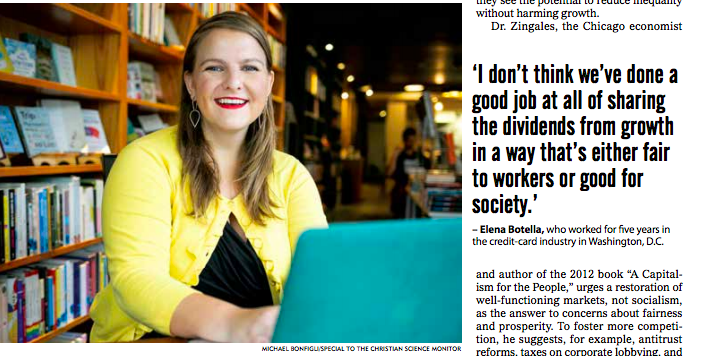
There is no way I could really summarize everything that happened over those five years, except to say that when I left the office for the last time a few weeks ago, I was a little teary-eyed with gratitude for a place and for people that had treated me well and had pushed me to grow, while also feeling ready to be more on the “outside,” to be able to speak and think and write about the economic issues facing American families in different ways.
Was it hypocritical to draw a paycheck for five years from a credit card company, while also thinking America’s banking system still needs major structural reform?
If you believe that, I won’t argue with you. I’m not going to throw any punches back at those who would question the choices I’ve made, or who would point out that I have financially benefited from the fact that American families can’t make ends meet — that fact is obviously true. I’m ready to sit down to listen to any critic of a bank who will sit down with me.
At the same time, I am sure that as a result of that experience I’m in a better position today than I was five years ago to make headway and progress in figuring out a more humane banking system.
After returning from a few weeks of vacation in North Carolina and meeting my beautiful newborn niece, I’m back in Washington D.C.
I’ll be getting started on a longer term writing project interviewing Americans about their experiences with unsecured credit and debt. I expect to do some travel for that project, so if you would be willing to be interviewed or know someone else who would be willing to tell their story, please be in touch. I’ll also be doing some shorter term writing projects I just made my first visit to the D.C. Bankruptcy Courts – I’ll keep you posted) and may do some consulting on the side. I anticipate applying to grad school either this cycle or next, despite yesterday’s devastating takedown of academia written my brilliant college roommate Andrea Chu, so if you have any advice or warnings about that, please share as well.
I’m excited for what’s next, but also nervous — both to be accountable for structuring all my own time, but also to grapple with some difficult truths with the hopes of distilling some nuggets of insight that are useful in some way.
Stay tuned!