Categories
Jobs and Working

What a job search custom tells us about the death of free-market egalitarianism

In the Wealth of Nations, Adam Smith imagined a pin factory with ten workers, and predicted that capital owners would be on the factory floor doing manual labor alongside their employees. Instead, Amazon packs thousands of workers into each of its warehouses, and some of those workers reportedly pee into plastic bottles for fear of getting disciplined if they “waste time” on bathroom breaks. Meanwhile, Jeff Bezos is a millionaire, 151,000 times over.

In my latest essay for The Outline, I talk about how the custom that job candidates should send thank-you notes to their interviewers fits into a long history of workers being placed socially and culturally beneath management.

This piece was a lot of fun to write. I’ve been very inspired by philosopher Elizabeth Anderson recently, and I’m excited to keep exploring her ideas.

Categories
Banking Jobs and Working

“The wealth continues to circulate within white cultures and white groups:” Reflections on diversity and inclusion in banking

In last week’s episode of a Me and a Bunch of White Girls, Laura, a diversity and inclusion consultant, described how her experiences in the financial sector motivated her to tackle D&I work:

America has so many problems, and this [lack of diversity] is one of them. We continuously keep these spaces so white. [….] Especially in the financial industry, there’s not enough black and brown people. The wealth continues to circulate within white cultures and white groups. Black and brown people aren’t making it into these spaces to influence where the money flows, or to get the money themselves.

Obviously, those who want to dismantle capitalism itself would critique her argument – why should women and people of color choose to participate in an extractive system? In that way of thinking, trying to make banking more diverse is one of those ‘surface-level’ fixes that might entrench inequality even more deeply (re: this Onion article – “Shocking: The Average Female CEO Only Makes 258 Times What Her Employees Make”).

Laura draws a brilliant connection between the internal problems that banking has with diversity and inclusion and the failure of those institutions to systematically improve the lives of ordinary Americans. A more diverse banking sector wouldn’t be good only for the women and people of color who would reap the professional benefits of membership – it’s also necessary for developing a financial sector that does more good than harm for the majority of people.

Banking fails to see the real value of diversity

When I worked at Capital One, I did ‘mock interviews’ for people (mostly students applying for their first job out of college) who had passed the resume screen and would be interviewed soon. Later, I conducted interviews for campus and professional hiring of analysts and product managers.

One mock interview I did stood out to me. The student was a senior at Duke, and a member of Mi Gente, the school’s Latin/x organization. His public high school in Los Angeles was primarily Mexican-American and predominantly low-income.

Like many banks and consulting companies, we used ‘case interviews’ to screen candidates. Prospective analysts were given a business problem to solve in a way that usually has a ‘right answer.’ Our mock interviews use cases that were several years old and had been retired out of the old interview pool. 

This case asked candidates to evaluate whether a sandwich shop should run a promotion to price their 12-inch sandwiches at $5. In the case, you’d consider things like whether demand increases enough to offset the lower prices, and what happens if customers shift their mix of purchased sandwiches from cheap ingredients like tuna to more expensive ingredients like steak as a result of the promotion. To start you’re told only the basics and are asked: “What types of things should the sandwich shop consider before running the promotion?”

The student answered, “They should think about what $5 means in the context of the neighborhoods where they’re located. At Duke, a $5 sandwich would be a relatively good deal, but where I grew up, that would be a pretty expensive lunch.”

His answer exactly illustrated what banking needs more of:people who can contextualize what business decisions will mean in the lives of the communities that banks need to better serve. Like many companies, Capital One had programming to encourage applications from underrepresented minorities – things like funding diversity scholarship, and hosting events with black and latino student organizations – but they were missing a framework for recognizing organizational blind spots, and seeing how people of color and women could eliminate those blind spots. I think most of corporate America has some basic diversity awareness, roughly at the level of: ‘oh, wow, way less than half of Americans are white men so if we only hire white men suuuurely we must be missing out on at least a few qualified people.’ But predominantly-male and predominantly-white workforces miss out on so much more than ‘extra people.’ There needs to be spaces on both our literal and metaphorical talent rubrics for the people who can come and explain to everyone else what they’ve been missing.  

Banking and other ‘elite’ professional cultures continue to be exclusive

Louis Hyman’s 2018 book Temp discusses the stratification into the workforce into secure and contingent employment, and in it, he chronicles how the rise of consulting firms helped created that economic order. In doing so, he also highlights the social culture of consulting, and his description still rings true for the cultures in ‘elite’ professions like banking, consulting, and law: 

As much as consulting was mental, it was also athletic. The consulting life was hard and the consultant needed stamina […] Spending ten to fourteen hours in a day in a room with colleagues you had never met before was a recipe for disaster unless the associates had exceptional social skills or similar social backgrounds. By recruiting from the same elite schools, McKinsey helped reinforce a shared social background. Bower said that in the 1940s he would only hire an associate he ‘would be glad to go on a tiger hunt with.’ Self-presentation mattered as much as ideas. Even though Bower believed in intellectual iconoclasm, he also believed in social conformity. McKinsey men did not look better or worse than their clients. Conformity in style meant the clients would listen to new ideas.

A 2016 randomized controlled trial published in the American Sociological Review found that top law firms penalized candidates that appeared to be from poorer class backgrounds:you were better off having been a ‘peer mentor for first year students’ than a ‘peer mentor for first-generation college students’, for having done sailing rather than track and field, and for having received a generic athletic award rather than an award for outstanding athletes on financial aid. And of course, hiring discrimination against women and people of color is also well-documented.

Questions like “is this person a culture fit?” mean so much more than “let’s make sure we don’t hire someone who’s a massive jerk” but also “does this person conform to my subtle expectations for how the people around me should speak and look and act?”

I’m not especially optimistic about this changing – even if it would be in firm’s best interest to do so. Part of this is a ‘management capitalism’ versus ‘shareholder capitalism’ problem – e.g. that employees desires to work with other people of the same racial and class background is strong enough that they’ll discriminate at their company’s expense. Banking has such an incredibly profound impact on Americans lives though, so I hope Laura and others will keep trying.

Categories
Financial Regulation

Cryptocurrencies are pointless. You should pay attention to them anyway.

I have never been hyped up about Bitcoin, the “blockchain,” or cryptocurrencies.

The basic premise behind Bitcoin is that it’s a currency you can send anywhere nearly instantly. The computing power of the millions of bitcoin “miners” is used to solve math problems which create a secure record of every Bitcoin transaction – that record of transactions is called the “ledger.” The miners get paid for keeping the system running by receiving a share of the small amount of new Bitcoins that are being continuously released. Anyone can see the code, and everything is “decentralized” — instead of a single central bank or government holding the power, lots of people participate and everyone can ‘verify’ each other, which makes it a “trustless system.” In theory, you can count on things working without putting faith in the other players. Other “cryptocurrencies” generally share important parts of that architecture – especially the decentralized record-keeping called the “blockchain.”

Now, it’s clear that in places where the local currency has completely broken down, it’s clear that Bitcoin can be really useful.

Venezuela has been struggling with chronic food shortages. President Nicolas Maduro’s government won’t let its citizens exchange bolivars into foreign currencies at a price that any international exporters will accept, making incredibly difficult to import food into Venezuela. Malnutrition is skyrocketing, and estimates suggest that infant mortality has increased more than 100-fold since their economic and currency crisis started. Jim Epstein has reported that many members of what used to be Venezuela’s middle class and upper classes have stopped other work to mine Bitcoin. Former doctors, lawyers, and engineers use Bitcoin to buy Amazon giftcards, and then use the Amazon giftcards to buy food which gets shipped to Miami, and then sent to Venezuela at a hefty fee. Yeesh.

In most of the world though, including in most of the developing world, if you have money to spend, moving your money where it needs to go isn’t a big problem. Remittances–sending money between countries–can still be costly, but for “low-tech” reasons that Bitcoin isn’t really able to solve.

There just aren’t that many reasons why people in the United States who aren’t trying to commit crimes or buy banned goods would find Bitcoin useful, and while it is kind of fashionable today to express the opinion “oh, I think ‘the blockchain’ is very promising even though I’m not a believer in cryptocurrencies,” personally I’m not even that optimistic about what blockchain technology will accomplish for the reasons explained by Kai Stinchcombe here.

Once I learned enough to feel like I understood the basics, I started mostly tuning out cryptocurrency news.

My general assumption was that if Bitcoin, Ethereum, or other smaller ‘coins’ either fizzle out or simply fail to ‘take off,’ it would be a big bummer for the people who invested heavily, but that life would continue on as normal the rest of us.

After a great conversation about this topic with a mentor in Durham (Check out his paper on CTFC regulation of bitcoin derivatives), I’m starting to think differently on why cryptocurrencies could end up mattering a lot, even if they aren’t “successful.”

Things often grow from small and “addressable” to big and scary without making a lot of noise along the way

Of course, Bitcoin, Ethereium and other coins have already seen both massive ups and downs in their prices. Early this year, Bitcoin’s price fell by 60% without causing any obvious problems majority of people who don’t own cryptocurrencies. We can’t take that to mean though that contagion wouldn’t spread in future crashes.

Today, cryptoassets represent a relatively small part of the economy, and an especially small amount of what is held by important institutions like governments, retirement plans, or deposit-holding banks. Imagine cryptoassets as the sapling of a plant that would be comparatively easy to rip out of the ground now – a plant that could blossom into something a beautiful flower, intractable kudzu, or nothing at all. It’s tempting to wait to and see what happens – but by the time the trajectory is obvious, it may be too late to forestall big problems.

Importantly, derivatives allow the amount of exposure held in the economy related to a particular asset to grow far beyond the size of the underlying asset class. I might have one mortgage, but in theory, an infinite number of people can place bets on whether or not I’ll repay my mortgage. Similarly, there might be $X in bitcoin in circulation, but there can be 10 times that amount in outstanding ‘bets’ on whether bitcoin’s price will go up or down.

The ideal time to place regulations on mortgage-backed securities wasn’t in 2009 in the midst of the crisis, or even in 2006 just before the crisis started, but probably a decade or more before as the asset class was growing and evolving.

What do we do?

Push back on government entities holding cryptocurrencies or associated derivatives:

Voters and citizens should be concerned with the investments held by the cities, states, and countries where they live. For most of us in the United States, the most important government investments are the pension funds of our state governments. In many parts of the country, including my home state of North Carolina, pension funds are managed by an elected State Treasurer. When state pension funds struggle, either former public servants get short-changed, or ordinary taxpayers are suddenly on the hook to fund the promises made. State pension funds can be tempted into ‘novel’ investments, especially if they’re worried about making ends meet down the road – but voters should push back on government entities holding cryptocurrencies or associated derivatives.

There are huge, important differences between investing in a stock and investing in a currency. If you bought 100% of the stock of a company, you would then own that company – you would then get to keep all of the profits from that company’s activities, and you’d also own any of that company’s assets.

If you bought 100% of a currency, that currency wouldn’t be very useful anymore.

Stocks are productive assets – on average, while some companies will fail, companies on average grow and become more valuable over time, which makes the underlying stocks more valuable over time for “good reasons.” Currencies on average do not become more valuable over time – unlike the stock market where most people can be “winners,” investing in currencies almost always zero-sum game where you’re betting on one currency becoming more valuable in relation to another currency. Investing in stocks or bonds lets you direct money to governments or businesses that need funding to do research or build things like roads or factories – but when money is sitting in currencies, it really isn’t “doing’ anything. You could say that investing is putting your money into places where adding money is likely to create growth, while speculating is finding someone who will take the opposite side of a bet with you that something is going to grow or change on its own. We often need our governments to invest on our behalf – but we should ask them not to speculate on our behalf.

Some entities have great reasons to buy currencies or associated derivatives. If you are a manufacturer that buys raw materials in the United States, manufactures something in Mexico, and then sells it to a European market, a big swing in the exchange rate between dollars, pesos, or euros could really put a wrench in your business, so you may want to ‘stockpile’ some of the currencies, or buy “derivatives” that let you lock in a future exchange rate. While an importer or exporter might want to buy foreign currency or foreign exchange derivatives to manage their exchange rate risk, there’s really no good reason for a state pension fund to do so — and there’s not an obvious reason why anyone needs to be betting on the relative positions of dollars and cryptocurrencies.

This general point of view was expressed by the head of the California State Teacher’s Retirement System, the nation’s second-largest public pension fund when a spokesperson told CNBC: “CalSTRS has not considered investing in bitcoin or cryptocurrencies in general […] We consider them the ultimate intangible and, at least right now, there’s no value behind them other than what other people will pay.” But CNBC reported in the same article that other institutional investors may be “on the fence.”

Reconsider how we regulate crypto-assets

There are a lot of variations of what this could look like.

Regulation can prevent or discourage some investors from holding cryptoassets. As an example, the fact the Security and Exchange Commission hasn’t approved any cryptocurrency “exchange traded funds” (ETFs) doesn’t prohibit investors from holding cryptoassets, but creates a hurdle that makes it less likely that institutional investors will choose to do so.

It may similarly make sense for Congress to pass legislation on the presence of cryptocurrencies or related assets in retirement plans – both pensions and 401(k)s – either through a cap on the percentage of of a retiree’s investments that can be held in cryptoassets, or an outright prohibition on the presence of these assets in retirement plans. Conceptually, this isn’t so different from the Employee Retirement Income Security Act of 1974, which prevented companies from putting more than 10% of a pension plan’s holdings in the company’s own stock.

Of course, it is completely possible that cryptocurrencies have a bright future, that they transform how ordinary people make payments and that they’ll become genuinely useful. My real point is that being a pessimist about cryptocurrencies is not a good reason to tune them out entirely.


Categories
Jobs and Working

What’s it like to make it from one rung on the economic ladder to the next?

When we talk about economic mobility (or the lack of it) in the United States, it’s easy to get lost in the statistics — missing what life is like for those who make it from one rung of the economic ladder to the next.

As you gain new opportunities, you face new conflicts — in my piece for The Outline, I talked to first-generation college graduates to understand what it’s like to bridge ‘different worlds.’

It goes without saying, but you are probably either a colleague or employer, educator or classmate of those who grew up in very different economic circumstances than you — and to create opportunity, you have to understand how your actions either welcome others in or shut them out.

Categories
Jobs and Working

One in four “gig economy” workers would take a normal job at a lower pay

In a recent working paper for the Federal Reserve of Boston, Anat Bracha and Mary Burke find that 26% of gig economy workers would accept a lower hourly wage to be able to work hours at a formal job instead of in the informal economy — even if the formal job didn’t come with benefits.  While informal and ‘gig’ jobs are sometimes presented as offering greater flexibility and autonomy, Bracha and Burke’s findings strongly suggest that many would gladly ditch gig work in favor of greater predictability.

Their working paper also finds that the census districts with the highest rate of informal and gig labor force participation have the lowest rates of wage growth. One likely reason why? In places with a lot of gig workers, there are a lot of people who would like to work more paid hours — and that competition to find work drives wages down.  Importantly, they find that wage growth is much more negatively tied to gig labor force participation in census districts than it is negatively tied to the unemployment rate.

All-in-all, their work suggests that our low “headline” unemployment rate of 3.7% may be misleading — people who would have previously been counted as unemployed now have more opportunities to pick up hours delivering food, driving passengers or walking dogs.

Obviously for many people, that’s better than not earning any money, but we’re probably not at “full employment” yet when so many people wouldn’t count themselves as “fully employed.”  That may indicate the Fed is moving too quickly in raising rates.


Categories
Banking

Banks should measure their social impact


In a column for the American Banker, I’ve shared my thoughts on the ‘why’ and ‘how’ of using analytics to make banks more socially responsible.


Categories
Economic Policy

‘Faces of a new economy’ – my thoughts on the economic order

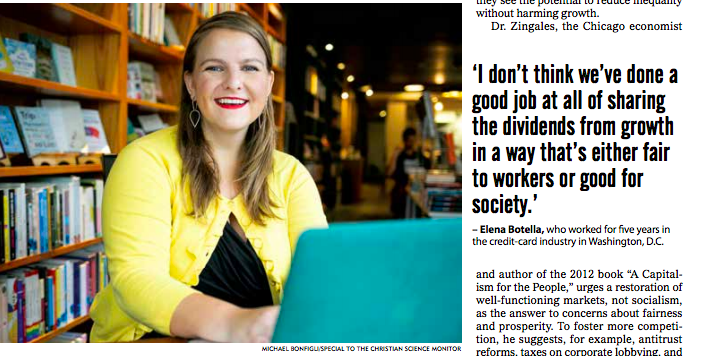
Mark Trumbull writing for the Christian Science Monitor profiled millenials rebelling against “an economic system that puts profits over fairness and equality.”

The word ‘socialist’ means different things to different people.  To some, countries like Sweden, Norway, or Germany are ‘socialist’ — many Western European countries have higher taxes, particularly on their wealthier citizens, to support free or very low-cost college and healthcare, and stronger guarantees of meeting the basic human needs of their citizens.  At the same time, those countries all have vibrant market economies. While some industries in those countries like healthcare or education may be fully public or operated with greater government intervention, citizens can also start and grow businesses, and private enterprise thrives. Writing for Forbes, Jeffrey Dorfman commented that the Nordic model is closer to “compassionate capitalism” than socialism, and observed that the success of both small and large private businesses in those countries is what generates the wealth to pay for the the system of social supports. With that in mind, I don’t label myself a ‘socialist’ in that I don’t think government ownership over the means of production is the best way of building a world where everyone can thrive.  I’m working towards an America where high-quality education is available to everyone, and where nobody who is working or is willing to work has to worry about affording food, housing, or healthcare  — and where people are free to try new things in the economy as long as they don’t cause harm to people or the environment.

Here’s some reading about how I think we get there:

  • Wealth taxes: A truly massive share of the world’s growth goes to those who own and inherit capital, as opposed to workers, inventors, and entrepreneurs.  We should raise income taxes on high earners, and have higher capital gains taxes, but I think wealth taxes are an important and rarely discussed piece of the puzzle
  • Public healthcare: countries like Spain are able to spend substantially less on healthcare per person than the United States with high quality and longer lifespans
Categories
Debt

Department of Homeland Security officials want to check immigrants’ credit scores. That’s a terrible idea for reasons nobody’s talking about.

Since 1882, the United States has denied immigration visas to those who were deemed “unable to take care of himself or herself without becoming a public charge.” This principle has applied also to the renewal of visas of those already legally living and working in the United States, and in some cases, resulting in the deportation of people whose visas were otherwise still valid.  

For the past twenty years, while nearly all undocumented immigrants and many legally-documented immigrants have been ineligible for a range of public benefits, the only people labeled as “public charges” were those who got more than half of their income from cash-based public benefits.  

Trump’s Department of Homeland Security wants to redefine who counts as a “public charge:” substantially lowering the threshold for how much assistance is considered unreasonable, beginning to include a much wider range of programs like food stamps and tax credits in the calculation. They also want to start factoring in a bunch of personal data like your family size and credit score to “guess” who might become a public charge in the future. In their Notice of Proposed Rulemaking, DHS recommends that U.S. Citizenship and Immigration Services “consider an alien’s liabilities and information of such liabilities in a U.S. credit report and score as part of the financial status factor,” claiming that “a lower credit score or negative credit history in the United States may indicate that a person’s financial status is weak and that he or she may not be self-sufficient.”

There have been a number of illuminating articles on what the change in the public charge definition would mean for families who are forced to trade off between making sure their family has food and medicine against the risk of deportation for having sought government assistance. Of course, these changes are in the broader context of the obvious moral problems with “kicking out” families who are doing the best they can. There’s also the practical consideration that a short-term reliance on a de minimis amount on public benefits doesn’t mean a person won’t over the long-term contribute positively to the federal budget. 

Beyond all these problems, there’s also some more specific problems with using somebody’s credit score to determine whether to renew their visa, and those problems haven’t gotten a lot of attention.

Relying on proprietary, third-party algorithms

You’ve probably heard of “FICO,” the most popular credit score. FICO uses the information found on the credit reports maintained by the private credit bureaus Equifax, Experian, and Transunion to calculate a score intended to predict your likelihood of repaying debts.  While a credit report is a list of (not always accurate) pieces of information about you, like your amount of outstanding debt and your payment history on your loans, credit scores are substantially less transparent.  While anyone living in the United States has a right to check their credit report once per year for free from each of the three major credit reporting agencies — Equifax, Experian and Transunion — along with the many additional smaller credit reporting agencies, there is no corresponding right to see your credit scores.  

Not only that, the formula used to calculate your FICO and other credit scores are secret — when lenders, landlords, employers, or the credit bureaus Equifax, Experian or Transunion want to see or use your FICO credit score, they have to pay the FICO Corporation.  

While lenders rely on credit scores like FICO because they are correlated with a borrower’s likelihood of repaying debts, the statistical relationships aren’t causal: having a higher or lower credit score doesn’t mean that a person has been more or less financially responsible.  A person with more unused credit available to them will receive a higher score than a person with less unused credit available to them, even if the two people have made identical payments on an identical amount of debt. Similarly, a person with 10 years of credit history will receive a higher score than a person with 2 years of credit history, even if both people have always paid all their bills on time.  

When we make decisions that are so massively consequential to families’ lives based on algorithms that are kept secret from the public, it raises a number of risks. To start, it raises the fairness issues when there are variables being used in the algorithm that are either irrelevant to the decision at hand, or worse, variables that are discriminatory or biased.  Importantly, a piece of information that is fair to use in one decision may be unfair to consider in an unrelated decision — for example, most people would consider it appropriate to use someone’s SAT score to decide who gets a college scholarship, but not in deciding someone’s criminal sentence. The variables that are legitimate to include in credit scoring models aren’t necessarily the same variables that are legitimate in making immigration decisions — and when the models aren’t open to the public, nobody is able to protest or raise issues when that occurs.

The lack of transparency around credit scores makes the situation ripe for scams from those who falsely claim they have the hidden keys to the ‘secret kingdom.’  Immigrants and non-immigrants alike are already targeted by ‘credit repair companies’ that make fraudulent claims about their ability to raise a consumer’s credit score.  

Ripple effects of deporting the highly indebted

Failing to renew an immigrant’s visa based on their credit score would be a massive hardship for her and her family, but it would have broader consequences for the economy as well.  

Having a high amount of debt can result in a low credit score, even if all debt payments are being made on time — meaning that relying on credit scores in making immigration decisions could result in deportation of those carrying high amounts of debt, even if the person is a model community member in every way. 

And who carries significant debt?  For starters, entrepreneurs.  71% of small businesses carry debt, and 3 out of 4 times, that debt is $25,000 or more.  Larger businesses may qualify for loans that are entirely based on the firm’s credit-worthiness rather than the owner’s, but loans to brand-new companies will typically require a personal guarantee from the owner, and be reported to the owner’s personal credit report.  Contrary to the rhetoric around immigrants as ‘job takers,’ they are especially likely to be job-makers, starting new businesses at a higher rate than their U.S. born peers. Small businesses built by immigrants employ 14% of all private-sector workers in the United States. 

54% of dry-cleaning businesses and 53% of gas stations are immigrant-owned. Image courtesy of Laurie Avocado, Creative Commons.

Suddenly, we’re not just considering the impacts of using the credit score on the immigrant and her family — now it touches her employees and customers.  There’s another stakeholder who has a huge vested interest as well: the lender.

Whether the immigrant borrowed money for a business, for education, a car repair or a medical emergency, the lender will want to see the debt repaid — and the odds of that happening drop considerably if the the borrower gets deported. An immigrant forced to leave the United States is likely to see a big drop in her earnings, and hence, her capacity to repay debts. And even if she still has the money to repay the debt, will she have an incentive to? It’s much easier to walk away from a loan if you’re outside the jurisdiction of the U.S. court system, and if you don’t have a reason to try to keep your U.S. credit scores high. This is obviously disadvantageous to the lender, and would have the strongest impact for credit unions and local banks that focus on serving immigrant communities. Fair lending laws prohibit banks from discriminating based on national origin, but that doesn’t mean that credit access for immigrants wouldn’t start to dry up if lenders realize that the very act of extending an immigrant credit could get that immigrant kicked out of the United States down the road.

What comes next

The broader set of changes around the ‘public charge’ determination will be more consequential than the specific language around using credit scores to determine visa renewal.  Given President Trump’s disturbing and inaccurate rhetoric about immigrants, a policy that is punitive towards immigrant families may be exactly his intent, even if such a change causes harm to U.S. citizens as well.   

That having been said, complex legislation and rule-making often comes with “typos” — ambiguities or inaccuracies that didn’t match the intent of the framers.  

A simple modification of the proposed rule to consider specifically “debts that are in a delinquent or defaulted status as reflected in an alien’s credit history” in lieu of “the alien’s credit history and credit score” wouldn’t impede the stated albeit already problematic goal of the rule change, “to ensure that those seeking to enter and remain in the United States either temporarily or permanently can support themselves financially and will not be reliant on public benefits,” but would be fairer, more transparent, and have fewer negative consequences for broader communities.  

Categories
Credit Cards Financial Regulation

Are credit card rewards even good for consumers?

Earlier this week, the Wall Street Journal reported that merchants like Home Depot, Target, and Amazon are becoming increasingly frustrated with the high fees they pay to accept rewards credit cards, and are seeking relief from the courts or through negotiations with Visa and Mastercard.   Particularly, merchants are looking for the networks Visa and Mastercard to end their ‘honor all cards’ rules, which say that if you accept any Visa credit card you need to accept all Visa credit cards, and ditto with Mastercard.

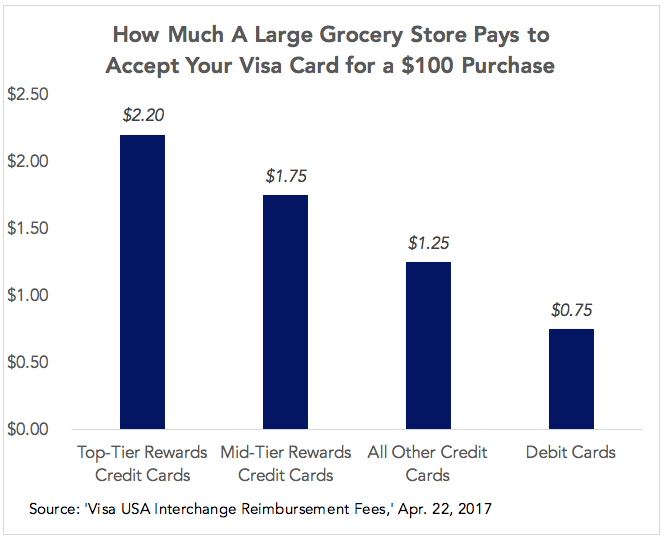
Today, if you spend $100 at a large grocery store, Visa would charge the store a $2.20 processing fee if you used a top-tier rewards credit card from their Visa Infinite line (like Chase Sapphire Reserve), a $1.75 fee you used a Visa Signature rewards credit card (like the Bank of America Travel Rewards Card), and $1.25 fee for any other Visa credit card, which are generally those without rewards.  By comparison, to accept a debit card, the processing fee would be 75 cents or less.

How much a large grocery store pays to accept your Visa Card for a $100 purchase; source Visa USA Interchange Reimbursement Fees

The article points out that rewards credit cards are incredibly popular with consumers – but do consumers actually win in the current system where merchants pay a fee to the networks (Visa, Mastercard, Amex and Discover), the networks pay issuers (Chase, Citi, Capital One, etc.), with much of the final fee getting sent back to customers in the form of rewards?

On the surface, the Americans who avoid paying interest on their credit card by paying their bill in full each month are getting a great deal – a family spending $1,000 per month on their credit card can easily net $200 per year in “free cash” from rewards.  Beneath the surface, things get more complicated.

A regressive system 

The most obvious flaw with the current system of processing fees and rewards is that stores raise prices to cover the fees – and because giving out a 1% or 2% percent discount to people who are paying with cash or a debit card can be clunky, those prices are usually higher for everyone, not only those paying with a rewards credit card.  On balance, that system is regressive, given that the Americans who primarily shop using their credit card are wealthier than the Americans who primarily shop using cash and debit.   Researchers at the Federal Reserve of Boston found that because of the price effects associated with credit card rewards, the lowest-income households, those that make $20,000 or less annually, pay an extra $21 per year in higher prices, and the highest-income households, making $150,000 or more annually, receive an extra $750 every year in rewards.

It was with these prices effects in mind that Australia and the European Union both passed rules limiting credit card processing fees to less than 1%.

But there’s another, more subtle, reason why credit card rewards may not be the boon to consumers that they’re made out to be.

Confusing the shopping experience

While some consumers use credit cards purely for the  rewards and convenience, 60% of active credit card users are “revolvers” who borrow money and pay interest on their credit cards.

For consumers that are going to borrow money using their credit card, picking out their credit card based on the rewards is like buying a house because you like the color they painted the bedroom – it just really shouldn’t be the most salient feature.

Credit card interest rates vary significantly – for customers with the best credit scores, Discover, BarclayCard and Capital One offer APRs as low as 13.74%, while subprime customers can expect to pay upwards of 25%.  That 12 percentage point spread is pretty significant when you consider the best credit card rewards hover around 2%.  And because interest compounds, the difference can become even more significant.

Consider a customer with a good credit score who spends $3,000, and pays off $100 each month.   At a 13.74% interest rate, they’ll pay $696 in finance charges.  Raise that rate by one percentage point and their finance charges will go up by $69.  Raise it by 2%, and the charges go up $141, landing at $837 paid to borrow $3,000.  By comparison, their rewards on that spend would have only been $60.

TV advertisements and popular comparison websites like CreditKarma and CreditCards.Com, paid by the banks to advertise their products, focus almost exclusively on rewards and perks, at the expense of comparing interest rates and fees.

This has been a meaningful shift over the last ten years.  The 2017 CFPB Consumer Credit Card Market Report found that while in 2002, only 20% of credit card mail solicitations advertised rewards, today, roughly 60% do.

In a world without credit cards rewards and perks, issuers would start competing again on interest rate, drawing people’s attention back to where it should have been all along.   The graph below pretty clearly shows how U.S. consumers focus has drifted – in 2004, Americans Googled credit card APRs and credit card rewards at a similar rate, while in 2018, credit card reward searches were more than three time as common.

Much of the change here has happened at the subprime end of the market, where consumers are the most vulnerable, and the least likely to pay their credit card bills in full.  In the three years between 2011 and 2014, the percentage of new subprime credit cards offering rewards rose to 58%, up by 37% points.

A “shrouded equilibrium” 

Mary Zaki, an economist at University of Maryland, has called the current credit card market a “shrouded equilibrium,” noting that lenders can avoiding competing on price because consumers have so much difficulty assessing how an interest rate translates into the cost to borrow.

Perhaps it’s not surprising that consumers would prefer to think about and compare based on rewards, which are ‘fun,’ compared to fees and finance charges, which are painful.

Some academics and experts, like Lauren Willis, Professor of Law at Loyala University, have proposed that regulators require credit card companies to start using ‘Smart Disclosures.’  While standard disclosures like the famous “Schumer Box” are a table of key terms, a ‘Smart Disclosure’ would leverage each consumer’s own pattern of purchases and payments to predict the total amount of fees, interest, and rewards that person would accrue.  There’s a lot to like about those proposals – but we might be better off in a world where most financial products were just simpler to begin with.

Categories
Banking Credit Cards Financial Regulation

What’s happening with consumer financial protection around the world

In the United States, there hasn’t been much positive policy action on consumer financial protection recently, at least not at the federal level.

But regulators and policy-makers in the United Kingdom, Australia and Singapore have been trying a range of solutions, some incremental and some radical, to make life better for borrowers in their countries.

You can read more in my post for the Duke Global Financial Markets Center’s FinReg blog.